Navigating Change – How Kim Bong Carpentry Village Adapts to Modernity
Yet in Hoi An, traditional craftsmanship has not simply disappeared in the face of technology. Kim Bong Carpentry Village has continued to adapt, finding new ways to connect its centuries-old woodworking heritage with the expectations of today’s customers while keeping the skills and character of traditional Vietnamese carpentry alive.
See more details >>> Discovering Kim Bong Carpentry Village – Where Hoi An’s wooden Legacy lives on
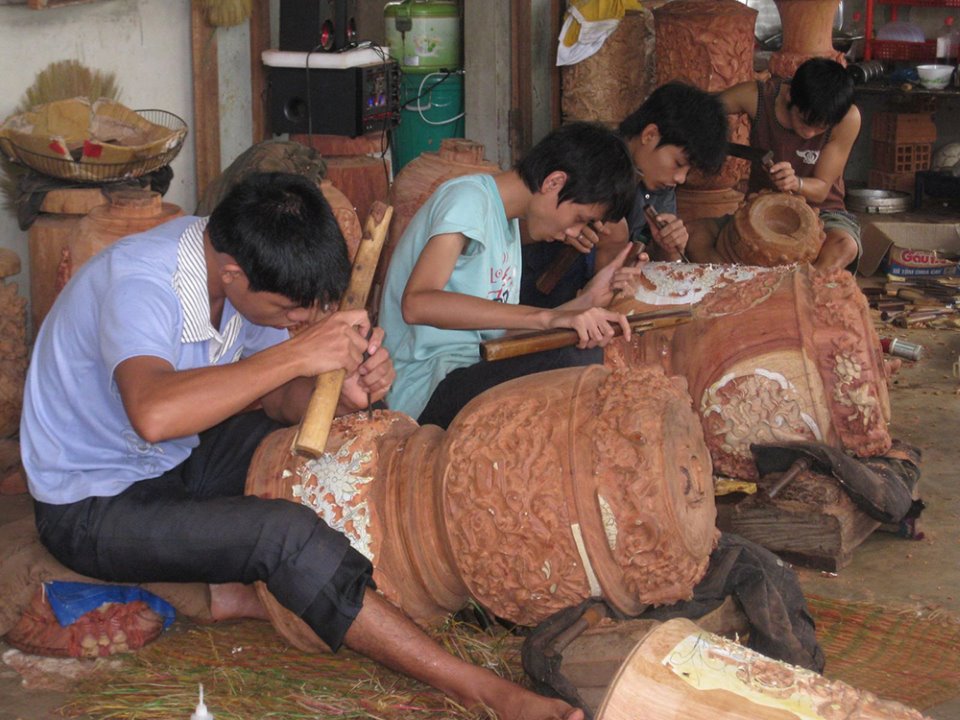
Kim-Bong-Carpenter-Village-Hoi An-Quang Nam
How Kim Bong Carpentry Village Is Responding to Modern Change
Kim Bong’s challenge is not simply about competing with machines. It is about finding a place for handmade craftsmanship in a market where customers increasingly expect convenience, contemporary designs, and competitive prices.
Rather than abandoning its traditional identity, local artisans have explored new opportunities. Tourism, product diversification, creative partnerships, and the transmission of traditional skills have all helped the village remain relevant.
Embracing New Horizons While Keeping Its Roots
Tourism Has Become an Important New Opportunity
One of the most significant changes has been the growing connection between Kim Bong Carpentry Village and Hoi An tourism. Visitors are interested not only in buying handicrafts but also in seeing how traditional products are made.
Artisans can showcase their skills through workshops, demonstrations, and visits to local woodworking areas. Watching a craftsman transform a rough piece of timber into a carefully carved object gives travelers a much deeper appreciation of the time and skill involved.
This tourism connection creates an additional source of income while helping visitors understand why traditional carpentry remains important to Hoi An’s cultural identity.
Traditional Craft Meets Contemporary Design
Modern customers do not always want furniture or decorations designed entirely in a traditional style. To respond to changing tastes, artisans can combine familiar woodworking techniques with simpler shapes, contemporary forms, and practical designs.
Today, visitors may encounter everything from traditional carvings and religious sculptures to modern decorative objects, smaller souvenirs, household products, and furniture designed for contemporary homes.
This flexibility allows Kim Bong craftsmanship to reach customers who appreciate handmade quality but prefer a more modern aesthetic.
Working with Designers and Creative Partners
Connections with designers, artists, architects, interior specialists, and tourism businesses can also introduce new ideas into traditional woodworking.
These collaborations may encourage artisans to experiment with different forms, functions, finishes, and product sizes. At the same time, designers benefit from the knowledge of craftsmen who understand traditional Vietnamese materials and woodworking techniques.
The result can be a productive exchange between old and new rather than a simple replacement of traditional methods by modern manufacturing.
Using Technology Where It Makes Sense
Modern technology does not necessarily have to be the enemy of handmade craftsmanship. In some situations, machinery and digital tools can help with repetitive or highly demanding tasks while artisans concentrate on the details that give a product its handmade character.
The important distinction is that technology can support the craft without completely removing the artisan’s role. For visitors, the value of a handmade Kim Bong product often lies in its individual details, human skill, and connection to local heritage.
Preserving the Traditional Knowledge of Kim Bong
Passing Skills from One Generation to the Next
A craft village cannot survive simply by selling products. It also needs people who know how to make them.
In Kim Bong, families and experienced craftsmen have traditionally played an important role in teaching younger generations. Apprentices learn by observing, practicing, making mistakes, and gradually developing the precision required for professional woodworking.
This intergenerational transfer of carpentry skills helps protect knowledge that cannot easily be learned from a machine or a written manual.
Keeping Traditional Designs and Techniques Alive
Traditional woodworking includes much more than cutting and shaping timber. It involves knowledge of proportions, decorative motifs, joinery, carving methods, tools, finishing techniques, and the cultural meaning of particular designs.
Preserving these elements helps ensure that modernization does not erase the identity of Kim Bong. New products can be introduced while traditional techniques and designs remain part of the village’s living heritage.
Greater Attention to Responsible Wood Use
Environmental concerns have also become increasingly important in modern craft production. Responsible sourcing of timber, efficient use of materials, and reducing unnecessary waste can help traditional woodworking respond to today’s environmental expectations.
For travelers purchasing wooden products, it is worth asking artisans about the material used, its origin, finishing process, and care requirements. Responsible purchasing can support craftsmen while encouraging more thoughtful consumption.
Why Handmade Craftsmanship Still Matters in a Machine-Made World
Modern machines are excellent at producing large quantities of identical products. Handmade woodworking offers something different: individual character.
A carved wooden panel may contain tiny variations that reveal the artisan’s hand. A sculpture can have subtle differences in expression or texture. Even two objects made from the same design may not be perfectly identical.
For travelers, this individuality is part of the attraction. A handcrafted item purchased in Kim Bong can serve as a physical reminder of a journey through Hoi An and the people who continue to practice its traditional crafts.
Tourism Helps Visitors Understand the Value of the Craft
One of the best ways to support traditional craftsmanship is simply to experience it. A visit to Kim Bong Carpentry Village allows travelers to see artisans working rather than viewing handmade products only as finished souvenirs.
You may see craftsmen measuring timber, carving decorative patterns, shaping components, assembling wooden structures, or working on detailed sculptures. The experience helps explain why handmade products can require considerably more time and skill than factory-made alternatives.
It also turns a shopping trip into a cultural experience—something that fits naturally into a wider Hoi An craft village tour.
Kim Bong as Part of Hoi An’s Craft Village Heritage
Kim Bong is not the only traditional craft community around Hoi An. Travelers interested in local craftsmanship can explore several villages and workshops, each with its own materials, techniques, and stories.
Visit Thanh Ha Pottery Village to discover traditional ceramic production and try a hands-on pottery experience.
For a closer look at natural materials and traditional weaving techniques, explore the Hoi An Bamboo Class and Workshop.
Textile lovers can join a Hoi An Silk Weaving and Embroidery Class to learn more about another long-standing local craft.
You can also make your own colorful souvenir during a Hoi An Lantern Making Class.
The Balance Between Tradition and Modernity
The future of Kim Bong does not necessarily depend on choosing between tradition and modernity. In many ways, its strength comes from combining the two.
Modern marketing and tourism can create new opportunities. Contemporary designs can attract new customers. Technology can support selected parts of production. At the same time, traditional skills, hand carving, local knowledge, and family-based training can preserve the identity that makes Kim Bong special.
This balanced approach gives the village a chance to evolve without losing the character that made its woodworking tradition valuable in the first place.
What Travelers Can Do to Support Kim Bong’s Craft Tradition
- Visit local workshops: Take time to observe artisans and learn about their techniques.
- Buy thoughtfully: Consider purchasing directly from local craftsmen when possible.
- Ask questions: Learn about the materials, production process, and story behind the product.
- Choose meaningful souvenirs: A small handmade object can be more memorable than a mass-produced item.
- Respect the workshop: Ask before taking photographs and keep a safe distance from tools and active work areas.
- Explore other craft villages: Combining Kim Bong with pottery, bamboo, silk, and lantern-making experiences provides a broader view of Hoi An’s creative heritage.
The Future of Kim Bong Carpentry Village
Kim Bong Carpentry Village demonstrates that traditional craftsmanship does not have to remain frozen in the past. A living craft must respond to the people who buy its products, the visitors who experience its workshops, and the changing world around it.
The challenge is maintaining the right balance. If artisans focus only on mass production, the distinctive character of handmade carpentry may disappear. But if traditional craft refuses every form of change, it may struggle to connect with new generations of customers.
Kim Bong’s continuing journey shows another possibility: adapt without forgetting where you came from.
For travelers exploring Hoi An, a visit to Kim Bong is therefore more than a chance to see beautiful wooden products. It is an opportunity to witness a traditional Vietnamese craft adapting to modern life while still carrying the knowledge of generations.
Explore Hoi An’s Traditional Craft Villages
Want to discover more of Hoi An beyond the Ancient Town? Add Kim Bong Carpentry Village to your itinerary and combine it with other local craft experiences, workshops, and countryside attractions.
See more Hoi An tours craft village as details:
Thanh Ha pottery village daily tour
Hoi An Bamboo Class and workshop
Hoi An silk weaving class and workshop
If confirm booking please send us the list includes: Name, date of birth, email address (if available) or mobile numbers to companies for buying insurance. Or send all information as your request via WhatsApp >>>


YOU MAY LIKE IT

Kim Bong Carpenter Products – How to Ship Your Hoi An Handicrafts to Your Hometown
Then comes the practical question: How can you bring a large, heavy, or delicate Kim Bong wooden product back home? Fortunately, buying a handcrafted item does not always mean carrying it...